We asked Northern Ireland history teachers to provide their opinions of the proposed TransformED History Curriculum for Northern Ireland. We circulated the anonymous survey amongst our members and received 89 responses. Participants were asked to rate their level of agreement with a number of statements relating to the new curriculum. In addition, there were a number of open-ended questions, which allowed teachers to expand upon their choices. This page contains a breakdown of the results from the Likert scales.
A big thank you to all those who took part in the survey.
Profile of the respondents
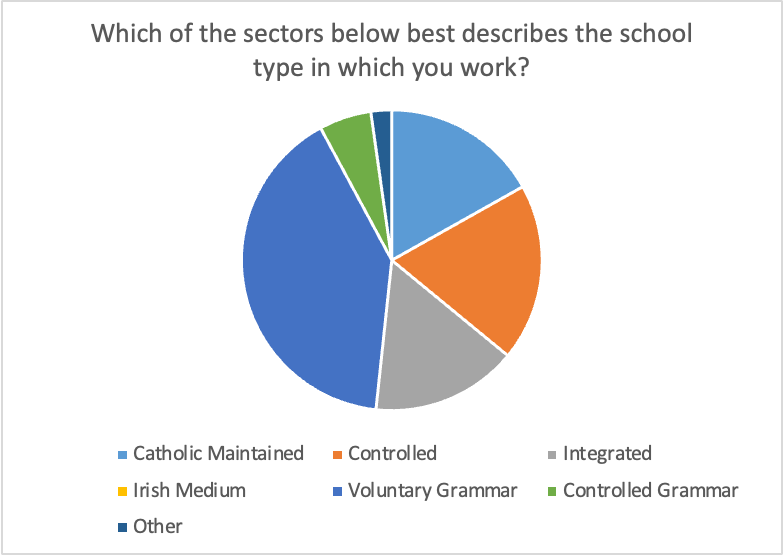
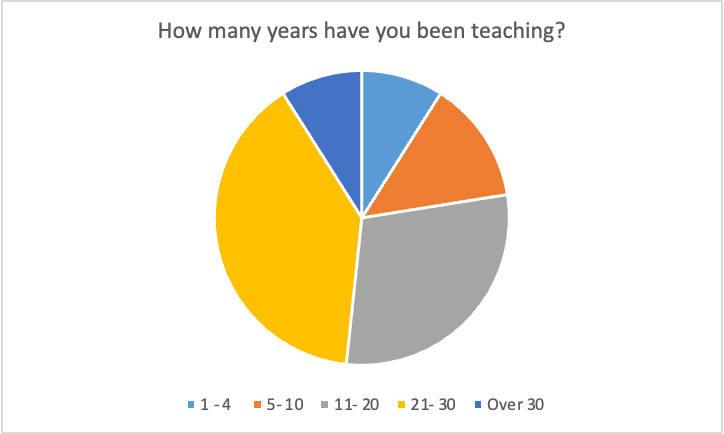
The majority of the 89 respondents were post-primary history teachers who have between 5 to 30 years’ teaching experience. Teachers from Controlled, Catholic Maintained, Voluntary Grammar, Integrated and Controlled Grammar schools were all represented.

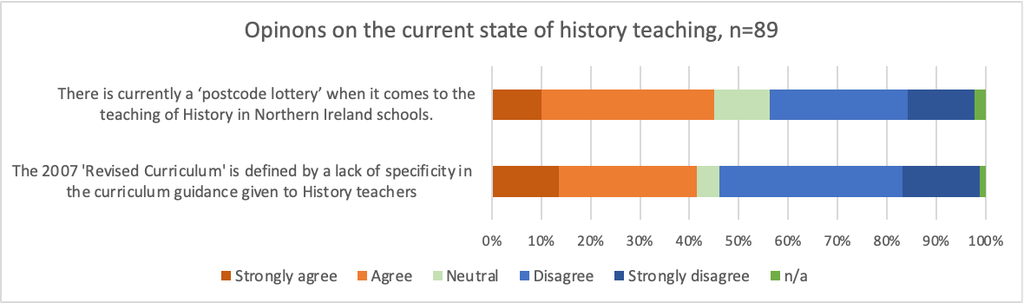
Teachers were asked about the ‘2007 revised curriculum’ and whether the specification affected the consistency of history teaching in schools. Forty-two percent of respondents agreed/ strongly agreed that the current curriculum lacked specificity and 45% respondents agreed/strongly agreed that this had lead to a ‘postcode lottery’ of history teaching.
Statements made in the Department of Education’s rationale and proposals for a new History curriculum at KS3.
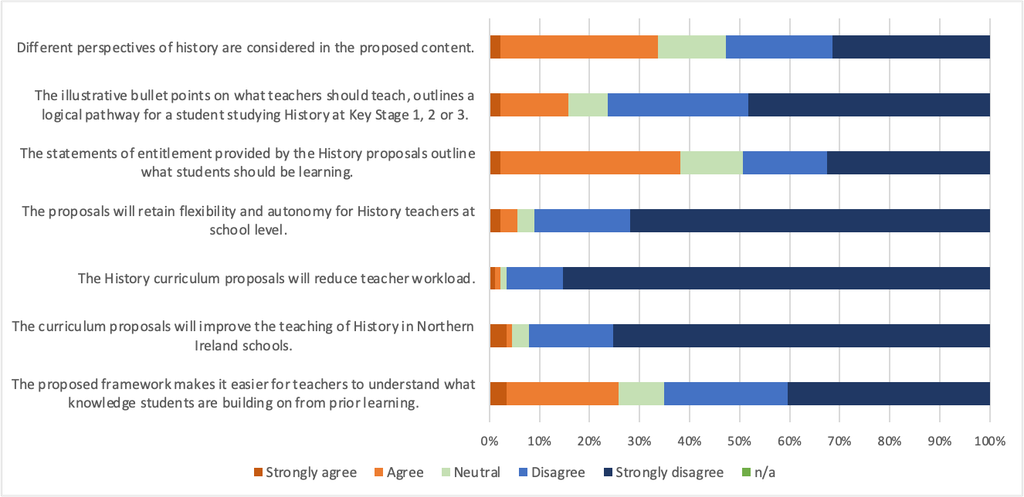
Respondents were asked to indicate their level of agreement with a number of statements concerning the TransformED History curriculum. The majority of teachers felt there were aspects of the new proposals that would negatively affect their history teaching. Overwhelmingly, 91% teachers disagreed/strongly disagreed that their flexibility and autonomy would be retained, while 92% of teachers strongly disagreed/ disagreed that the curriculum proposals would improve the teaching of history in Northern Ireland schools and 97% thought this would lead to an increase in workload.
Thirty-eight percent of teachers agreed/ strongly agreed (38% A/SA) that the statement of entitlement outlined what students should be learning while 26% of teachers (A/SA) believed that the proposed framework would help them to understand students’ prior knowledge. A third of teachers (34% A/SA) thought that different perspectives were considered in the content, with only 16% acknowledging that the illustrative bullet points provided a logical pathway through key stages 1 to 3.
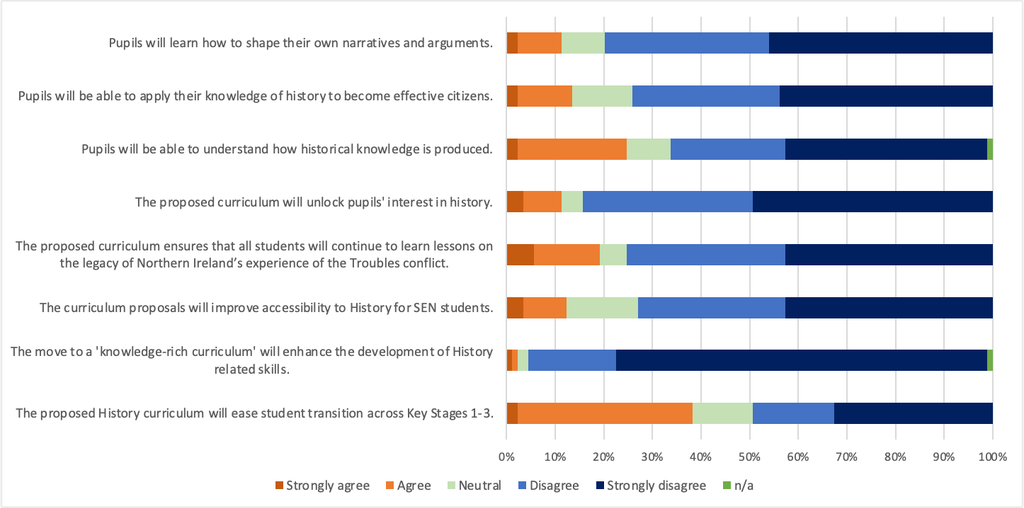
History teachers were concerned about how the new rationale would impact their pupil’s ability to acquire a range of history-related skills. Only 2% teachers agreed/ strongly agreed (A/SA) that the ‘knowledge rich curriculum’ would help students to develop history-related skills. Just 11% (A/SA) of respondents thought proposals would enable students to shape their own narratives and arguments, and the same proportion (11% A/SA) believed that the new specification would unlock a student’s interest in history. A similar percentage of teachers (12% A/SA) thought that the proposals would improve accessibility for SEN students, while 13% strongly agreed/agreed that the changes would enable students to become more effective citizens. More teachers admitted (38% A/SA) that the proposed curriculum would ease student transition across key stages 1-3, while a quarter of respondents (25% A/SA) thought it would facilitate students understanding of how historical knowledge is produced. However, only a fifth of surveyed teachers (19% A/SA) believed that the new curriculum would allow students to learn the lessons of the legacy of the Troubles.
European and international perspectives on History education.
Respondents were asked to indicate their level of agreement with statements on the nature of effective History education, drawing on standards from Euroclio, based in international standards from the Council of Europe and the United Nations.
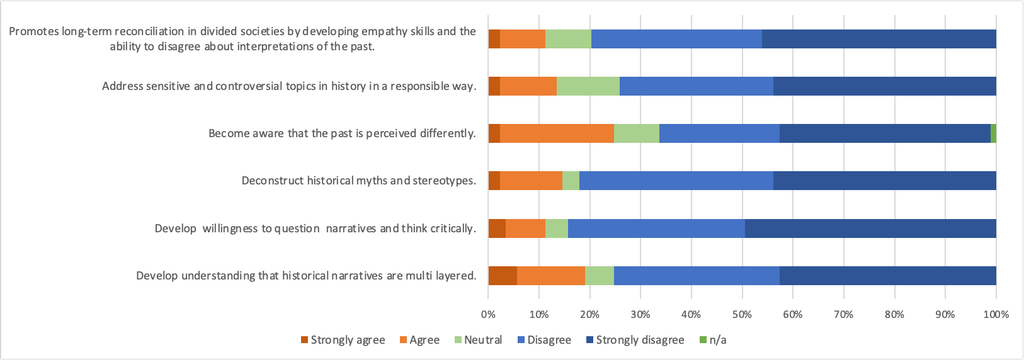
The majority of surveyed teachers were concerned that the TrandformED curriculum would not facilitate core historical learning experiences, especially those that are required to deal with nuanced or contested histories. Over three-quarters of teachers disagreed/ strongly disagreed (80% D/SD) that the curriculum would develop the skills of empathy and appreciation of different views or promote long-term reconciliation. Nearly two-thirds disagreed (65% D/SD) that the framework would help students to understand that the past can be perceived differently. Nearly three-quarters of teachers (74% D/SD) did not believe that the proposals addressed controversial and sensitive topics in a responsible way, and an even greater percentage (82% D/SD) of respondents did not think students would be able to deconstruct historical myths and stereotypes. Eighty-four percent of teachers (84% D/SD) thought the framework would not enable students to think critically and question narratives, while three-quarters (75% D/SD) thought pupils would not be able to recognise that narratives were multilayered.
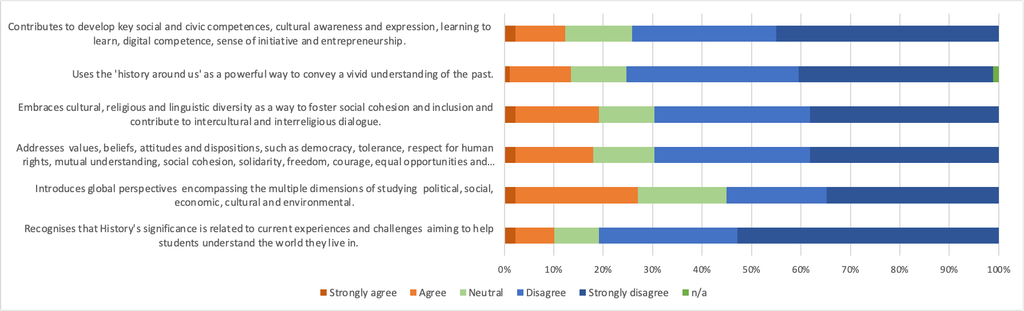
Almost three-quarters of surveyed history teachers disagreed/ strongly disagreed (74% D/SD) that the proposals used the ‘history around us’ to leverage understanding, even more respondents (81% D/SD) denied that the criteria mapped history learning to pupils’ current experiences. Over half of participants (55% D/SD) didn’t feel that the curriculum introduced global perspectives, whereas 70% (D/SD) didn’t perceive sufficient cultural, religious and linguistic diversity. The same percentage (70% D/SD) did not agree that a diverse range of values, beliefs and attitudes were addressed. Whereas, nearly three quarters (74% D/SD) of history teachers did not believe that the framework would develop key social and civic competences, cultural awareness and expression.
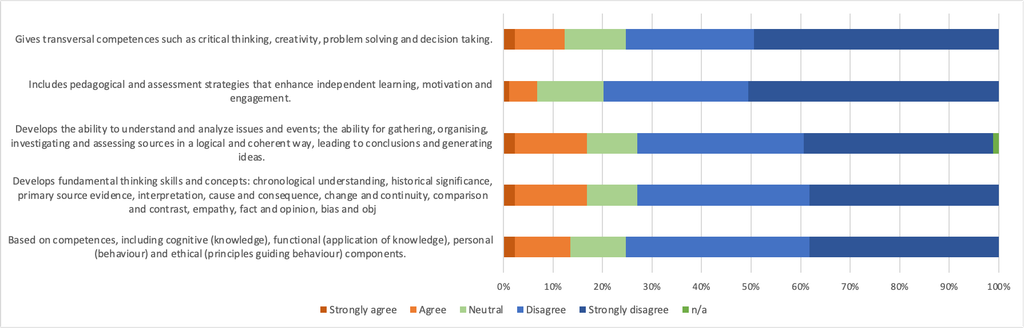
Survey respondents were also concerned that the new curriculum would not develop historical skills and competencies. Just 12% of participants agreed/ strongly Agreed (A/SA) that the proposal would support the development of critical thinking, creativity, problem solving and decision taking abilities, whereas only 13% (A/SA) believed that cognitive, functional, personal and ethical competencies would be developed. Even fewer respondents (7% A/SA) thought that the assessment and pedagogical strategies would enhance independent learning, motivation and engagement. A higher percentage (17% A/SA) believed that the framework would enable their pupils to understand and analyse issues and events, and gather, organise, investigate and assess sources. Whereas 17% (A/SA) thought that it would support their students to develop fundamental historical skills and concepts such as chronological understanding, historical significance, cause and consequence, change and continuity etc.
Workload and teacher autonomy
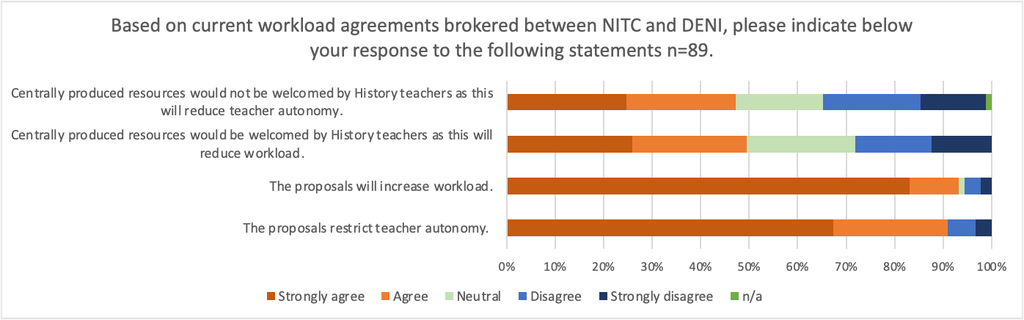
Over 90% of teachers believed that the proposed changes to the curriculum would restrict their autonomy (91% A/SA) and increase their workload (93% A/SA). While nearly half of teachers (49% A/SA) thought that centrally-produced resources would help to reduce the workload, there was some concern this would reduce their autonomy (47% A/SA).